TIforOA

Sanctify yourself through the permissible... Yevamos 20a

Divrei Torah to provide Chizuk in the struggle to balance spiritual and physical needs.

L'Iluei Nishmas Mirkah Bas Yosef


Showing posts with label Simchat Torah. Show all posts

Saturday, October 2, 2010

When less is more.

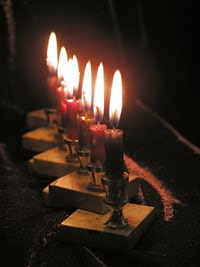
This Simchat Torah our shul had a black out. They made Hakafas by the light of the emergency escape lights. It was dramatically beautiful. The lack of "proper" light caused a dramatic focus that will stay with me for a long time. The crowd was small and spirited, and it felt like we were transported back in time to the days before electricity.

My einekle told my son she wanted the lights to go back on, he told her that Hashem would make the lights go on soon. She told him that. "Hashem can't make the lights go on, only a goy can turn the lights on on Yom Tov" A few minutes later, the emergency repair crew outside the shul got the electricity up and running. The brights lights went on, the overhead fans and the air conditioners went back on, but the intimacy left.

This got me thinking about the way that abundance in our lives can often mask small things that really count. When we pare down our needs and desires we often enrich our lives.
Posted by Picasa

Wednesday, September 29, 2010

Finding Torah inside of ourselves- from "Bilvavi Miskan Evneh"

Many people suffer very much from the fact that they feel a hole in their lives. They think that they are the only ones who feel and suffer. They look at the mitzvot and they are not getting the right sense of satisfaction out of it, so they may be tempted to look out of Yidishkeit for happiness. A man has to know that the pleasures outside of Yidishkeit will never satisfy them. It is like a princess who marries a farmer. Any gift that the farmer will bring her will never satisfy her. The pleasures of the secular world will never make us feel better. I examined all of the ways that people seek pleasure and realized that they will never fill the hole in my life. They all came down to nothing, they are not life, they are only distractions. The thing that is missing in our lives, is our connection to Hashem. Until we find a way to really connect to Hashem with all of our being, we will never feel better. The life that I am seeking is in me, the more Torah that I find inside of me, the better that I feel. There are times that we eat nice things, or go away on a vacation, but that is not life, that is rest or distaction, life is only found by connecting in a deeper way to the Torah.
The way to really connect to Hashem is to scream out to him and beg him to help you to form that connection. It worked for me, it will work for you.


from a shiur by "Bilvavi Miskan Evneh"
http://bilvavi.net/content/view/533/32/
Posted by Picasa

Tuesday, September 28, 2010

Why do we have two holidays for the Torah -- Shavuot and Simchat Torah?

If the holiday of Shavuot celebrates the receiving of the Torah, why was Simchat Torah -- immediately following Sukkot -- chosen as the day to end and begin the annual Torah reading cycle?
Furthermore, why do we have two holidays for the Torah -- Shavuot and Simchat Torah? They are also celebrated so differently. On Shavuot, we stay up all night learning Torah. And on Simchat Torah, we dance.
The need for these two holidays has been explained in a parable that has been handed down from generation to generation.
Once a king issued a proclamation. Any one of his subjects was welcome to try for the hand of his daughter. On one condition: The potential suitor was not allowed to meet or see his daughter before the marriage.
The proclamation caused quite a stir. Soon the local inns were buzzing with speculation and rumors. "I hear she is a real shrew," said one. "I heard she is a deaf-mute," said another. "I know for a fact that she is a total imbecile," intoned a third. Round and round the rumors flew. Finally, a simple wholehearted Jew spoke up. "I am willing to marry her. How bad can she be? After all, she is the king's daughter and we all know how great our king is."
Word quickly spread and the suitor was led to the palace. As it turned out, he was the only one who volunteered. The king accepted the match and the wedding date was set.
After the lavish wedding, the groom escorted his bride to their new home. She removed her heavy veil, and he was astounded at her beauty. Remembering the rumors of her reputed faults, the groom decided to thoroughly test her. He engaged her in conversation, tested her in character and refinement and found himself pleasantly surprised. In every way, she excelled beyond his greatest hopes and dreams. Overjoyed, he held a lavish party to celebrate his good fortune.
PARABLE EXPLAINED
The King in the parable is God. When He wanted to give the Torah, He offered it to each nation in turn. All the nations refused, each one claiming some fault in the Torah they would not be able to live with. When God offered it to the Jews, they said 'Naaseh VeNishma' -- "we will do, and then we will understand" (Exodus 24:7). The Jewish people accepted the Torah without having seen it, as they were grateful for all God had done for them.
Though the Jewish people fully accepted the Torah, they feared a loss. They assumed that the numerous obligations in the Torah would deprive them of their pleasures and freedom. Similarly, the groom in the parable married the king's daughter fearing he would be disappointed in other areas. But as the Jews learned the Torah and applied it's teaching to their lives, they were pleasantly surprised. Not only did they not have to give up anything, they found the Torah maximized their pleasure in every way.
Therefore at the conclusion of reading the Torah, when we have again delved into its teachings for a full year, we make a party on Simchat Torah.
On Shavuot, we stay up and learn all night to show our readiness and anticipation to receive the Torah. Because it is an intellectual appreciation, we stay up all night learning Torah. On Simchat Torah, however, we dance -- expressing the emotional joy of the body. We are showing that even our bodies have gained tremendously by keeping the Torah.
Ask anyone who has increased their Torah observance and they will tell you the same. At first, each feared, according to his or her nature, that some aspect of the Torah would be restrictive. Be it keeping Shabbat, kosher, family purity or laws of proper speech, each encountered an area that tested their resolve. However, they kept the Torah knowing it was the most meaningful thing to do. And as they grew in their Judaism, they found their lives enhanced in every way.
It is with this renewed appreciation that we approach Simchat Torah. We are filled with gratitude and awe for the great gift that God has bestowed on us with love.
((based on Otzar haShavous quoting Rav Avraham and the Dubno Magid)
by Rabbi Benyamin Buxbaum from Aish.com
Posted by Picasa

Monday, September 27, 2010

God adds a special day at the end of Sukkot, a day of great intimacy with our Creator, as He asks His Jewish children to remain with him for extra personal time together.

Imagine you throw a huge party and invite everyone you know. But this is no "regular" party: It's one solid week of food, music and fun. Eventually things wind down and people begin to leave. As the host, you quietly go over to a few of your best friends and whisper: "Stick around after everyone else leaves -- that's when I'm breaking out the good stuff."


Each year God has a weeklong celebration called "Sukkot." In ancient times in Jerusalem, the service in the Holy Temple during the week of Sukkot featured a total of 70 bull offerings. This, the Talmud explains, corresponds to each of the 70 nations of the world. The Temple was not just for Jews. When King Solomon built the Temple, he specifically asked God to heed the prayer of non-Jews who comes to the Temple (1-Kings 8:41-43). And the prophet Isaiah refers to the Temple as a "House for all nations" (Isaiah 56:7).

The Temple was the universal center of spirituality, a concentrated point where God-consciousness filtered down into the world. In fact, the Talmud says that if the Romans would have realized how much benefit they themselves were getting from the Temple, they never would have destroyed it!

And then, at the end of Sukkot, God added a special day. It's called Shmini Atzeret, literally the "Eighth Day of Assembly". On that day, only one bull was offered -- representing the Jewish people. It is a day of great intimacy with our Creator, as He asks His Jewish children to remain with him for extra personal time together. (Talmud - Sukkot 55b)

Shmini Atzeret is a full public holiday, as described in Leviticus 23:36. Even though it immediately follows the seven-day Sukkot festival and is often considered part of Sukkot, it is, in fact, a separate holiday. This means that the She'hechiyanu blessing is recited, and the obligation to sit in the Sukkah does not apply.

TAPESTRY OF SEVENS

Nachmanides (12th century Spain) explains a beautiful kabbalistic concept: Seven is the number of the natural world. There are seven days in the week, seven notes on the musical scale and seven directions (left, right, up, down, forward, back and center). "Seven" -- represented by the seven days of Sukkot -- is the world of nature. "Eight" -- represented by Shmini Atzeret -- is that which is beyond nature.

The Jewish people, says the Talmud, are beyond nature. We have survived every imaginable persecution, exile, hardship and expulsion. And still, we have achieved and thrived far beyond our numbers. As Mark Twain wrote: "All things remain mortal but the Jew; all other forces pass, but he remains. What is the secret of his immortality?"

The "secret," as we know, is the special gift that God gave to the Jewish people: The Torah. As Rabbi Emanuel Feldman writes:

"Torah is the mysterious bridge which connects the Jew and God, across which they interact and communicate, and by means of which God fulfills His covenant with His people to sustain them and protect them."

Therefore it is no coincidence that on Shmini Atzeret we also celebrate the completion of the yearly cycle of Torah readings and the beginning of a new cycle. This event is lovingly referred to as "Simchat Torah," literally "Rejoicing of the Torah." (Outside of Israel, Simchat Torah is celebrated the day after Shmini Atzeret.)

Why are we accustomed to both finish and re-start the reading of the Torah on the same day? The Sages explain: "To show that the Torah is beloved to us like a new object and not like an old command which a person no longer treasures. Since it is brand new to us, we all run to greet it." We sing and dance for hours around the bima (the platform where the Torah is read), carry the Torah Scroll, and express our joy at having the opportunity to come so close to God.

On Shmini Atzeret, as we complete this holiday season, we offer a special prayer to God for rain. Rain represents the blessings of growth and abundance. Through all the hard work of Elul, Rosh Hashana, Yom Kippur and Sukkot, we have come a long way. Our task now is to carry that energy throughout the year.

by Rabbi Shraga Simmons from Aish.com
Related Posts with Thumbnails