TIforOA

Sanctify yourself through the permissible... Yevamos 20a

Divrei Torah to provide Chizuk in the struggle to balance spiritual and physical needs.

L'Iluei Nishmas Mirkah Bas Yosef


Showing posts with label Shira Smiles. Show all posts

Thursday, February 9, 2012

Acceptence.

The only person you need to be accepted by is yourself, and you achieve this by bringing Hashem into our lives.  If our lives are focused on doing Hashem's will, we will be pleased with ourselves.  We have nothing to fear other than Hashem, becuase nothing is as real as Hashem.

from the Shiur on Naaleh:

Parshat Yitro: The Experience of Sinai
Teacher: Mrs. Shira Smiles Class: Added: February 07, 2012

Parsha For Our Lives 5772

Monday, January 23, 2012

Thank you Hashem for a year without Yishuv Hadas.

In a Shiur by Shira Smiles on Parshat Viera she said that we have to thank Hashem for what we don't have, not just what we have.  She also spoke about the reason that the frogs were such a difficult Maka was that they robbed the Egyptians of their Yishuv Hadas.  In light of this I am trying to find a way of thanking Hashem for the fact that I have not had any Yishuv Hadas for almost a year now.

  I have a lot to be thankful for in the past year, Health Insurance, warm and caring family members and doctors who helped me through a difficult time, modern medicine which makes major problems livable in the long term, and so much more.  But Yishuv Hadas was not there.  The longer that I think about this whole year, I feel that the biggest message that I can take out of it is that Hashem runs the world not me.  While this may seem obvious, it is a hard message to internalize.  I kept thinking that if I called one more doctor, or looked up one more thing on the internet, I would find an easy solution.  There are no easy answers.  Hashem is the final address for all of our problems.  To paraphrase Rabbi Weinberg from Aish,  we turn to Hashem for the answers to our problems, but we forget that Hashem gave us these problems to cause us to turn to him.

Therefore, I am thanking Hashem for my difficult year, with no Yishuv Hadas, because it helped me to internalize the fact that I can do and do and do.  But if Hashem does not want things to go well they won't. The opposite is also true.  I can make tremendous efforts to solve a problem, only to come up with a blank wall, and then I can turn around and find the solution fall into my lap through no effort of my own.

The biggest cost of my difficult year has been this blog.  Without Yishuv Hadas I was not able to post much. I am trying to get back to it, and I greatly appreciate all of the help that everyone has given me, in the past, and I hope to bring my blog back to it's former self.

Thursday, December 8, 2011

Building an eternal creation.

Sometimes when a builder builds a tall building he puts up a scaffolding to help him to build.  Would he ever dream of building it out of gold?  Of course not, the scaffolding is only temporary.  This is a good Mashal of our lives.  Our lives are temporary, but the eternal creation of our neshamah is for ever.  We should put the emphasis on the eternal creation and not our physical existence.  


Parshat Vayishlach: Faithful Follower
Teacher: Mrs. Shira Smiles Class:

Parsha For Our Lives 5772

Added: December 05, 2011 


http://www.naaleh.com/viewclass/2913/single/

Wednesday, December 7, 2011

Learning to Live the Torah

When Yakov says, "I lived with Lavan"  we learn from this that he kept all 613 mitzvot.  How can we say that he kept all of the Mitzvot?  The answer that Mrs. Smiles gives is that by learning all of the mitzvot and having the intention to carry them out, to the best of our ability, we are credited with keeping them.  She adds that this means not just keeping the mitzvot, but keeping the intent of the mitzvot.  She gives the example of Tznius, which does not only mean modest dress, but modest behavior.  I was recently reading the following post from Neil Harris:   http://uberdox.blogspot.com/2011/11/reb-moshe-and-broken-tape-recorder.html  where he told the folloing story that illustrates this idea, of not just learning Torah, but absorbing it.


Some years ago, in Rav Reuven Feinstein's yeshiva, there were two boys who had an argument.  What happened?  Let's call them Reuven and Shimon.  Revuen lent his tape recorder to Shimon and Shimon dropped the tape record and it broke.  And they were arguing.  Revuen said, "I lent you the tape recorder and you broke it.  You have to get me a new one."
Shimon says, "It wasn't my fault, it was an accident."
And they were arguing and decided that they would go to the Rosh Yeshiva, which is a good thing.  They went to Reb Reuven Feinstein, they went to the Rosh Yeshiva to ask him what's the halacha then.  This is what happened.  Rav Reuven Feinstein was absolutly astonished by the question.  Not with nachas, he was astonished.  He said, "You're learning all year since September, your learning the gemara.  Everyday you have charts on the blackboard.   You're learning the gemara "Bava Metzia" that teaches that when someone borrows something he's responsible when it breaks.  If you borrow something you're responsible."  Rav Reuven was so distrubed by this.  He couldn't understand how's it possible that the boy, how could he not know that? That's all they're learning and they're getting 100s on their tests. שואל חייב באונסין , it's a gemara.  It's all over the gemara.  If you borrow, you're chai'ev (responsible).
So, he was so upset, Rav Reuven went to his father.  He went to Reb Moshe, Zecher Tzaddik V'Kodesh L'Vracha.  He went to Reb Moshe and he asked, "How can it be that the boys did not know that?"
So, Reb Moshe said, "Because what they've seen in their lives has no relationship to what they're learning in yeshiva.  It's completely irrelevant.  They do not see their parents living the lives that they learn in the seforim, nor do they see it so clearly in the yeshiva."  That's what Reb Moshe said.
They would never dream of making a connection between what they learned all year and how to practically live.  It might have been taught, but it wasn't given over.


Dvar Torah from:


Parshat Vayishlach: Faithful Follower
Teacher: Mrs. Shira Smiles Class:

Parsha For Our Lives 5772

Tuesday, September 20, 2011

How can we call Haazinu a Shira when there is so much punishment in it?

The answer is that punishment is not something that Hashem does to take revenge on us, it is something that Hashem brings on us because it is good for us.  We understand that everything that Hashem does is for our ultimate good.  When we stand in front of Hashem before Rosh Hashanah we may feel discouraged when we think of the ways that we didn't do that we promised we would last year.  It is tempting to fall into despair and to feel that there is no use in even trying. We have to know that even when we are deserving of punishment, even though we seem to push Hashem away, he is always there.  In an effort to direct us in the right direction, Hashem will send nisyonos our way, but it is not to push us away, it is to bring us closer.  

from the Shiur 

Parshat Nitzavim & Vayelech: Symbiotic Song Teacher: Mrs. Shira Smiles

Lately I have spoken to many people who are all bordering on despair.  They feel that their lives have become so difficult that they do not know how they are going to keep going.  I feel that this answer is a very powerful insight to help us to get past this feeling.

Tuesday, August 30, 2011

Thoughts as we enter Elul.

To the extent that we are able to nullify ourselves, we become closer to Hashem.

from:   Elul: Month of Relationships
Teacher: Mrs. Shira Smiles

It is Rosh Chodesh Elul today and I am sitting in the hospital waiting for someone to get out of surgery.  I am grateful to Hashem for putting me in a position of helplessness as I wait for good news.  It brings me to a place of realizing that all of our plans are meaningless without Hashem's plans for us.   As I look around at all of the sick people around me, I realize again what a gift good health is.  As we contemplate the new year, we should be aware of all of the blessings in our lives.  If we can eat and breathe and walk and we have a roof over our heads, we have a lot to thank Hashem for.  Last year at this time, I never dreamed that I would have such a hard year.  Baruch Hashem I have the chance to beg Hashem for a year of good.

Sunday, April 10, 2011

Using the spiritual strength of Pesach to free ourselves.

Pesach is a time of freedom.  At this time of the year we are able to use this inherent strength to free ourselves from our Yetzer Harah and from our physical desires.


from: The Shiur on Naaleh:  Freedom from Self to Self

Teacher: Mrs. Shira Smiles Class: Jewish Calendar III (Pesach-Shavuot)
Added: March 28, 2011 Time: 59:26

Tuesday, March 29, 2011

Our focus-

Everything that Hashem gives us is not given for our physical pleasure, but to help us to grow spiritually.  This has to be our focus when we make decisions.

from: Parshat Tazriah: Narrow Vision
Teacher: Mrs. Shira Smiles Class: Parsha Topics - 5768

Friday, January 14, 2011

Why should I buy a special Esrog?

Remember: Tubeshvat is the time to daven for a special Esrog.

The pusuk says, "This is my God and I will glorify him", what does it mean to glorify Hashem, to glorify the Mitzot.  This is one of the sources to explain why we buy a beautiful Esrog, and special Tefilin.  When we do the mitzvot in a special way, we are really glorifying ourselves.


from a Shiur on Naaleh:
Parshat Beshalach: Glorifying the Glorified

Teacher: Mrs. Shira Smiles

Thursday, January 6, 2011

The Bracha of Gratitude

A person should always focus on gratitude. When we focus on all of the kindness that Hashem does for use open up new channels of Bracha. We gain the ability to see that life is not about me, and to develop humility.  The middah of humility is one of the best ways to acquire Torah.

from a Shiur on Naaleh:
Parshat Bo: Midnight Mindfulness  Teacher: Mrs. Shira Smiles

Monday, January 3, 2011

A message for all times

Rav Rice notes that at the beginning of the parsha, Hashem says, “Bo el Pharoh, Come to Pharoah.” Why does it say “Bo” and not lech, go? Additionally, if Hashem planned to harden Paro’s heart, what was the purpose of sending Moshe to him so many times?  The Kotzker Rebbe explains that when Hashem said “Bo,” he meant “Come with Me.” He was really saying, “I will be with you on your mission.”

 This is a message for all times. Even if we fall into the abyss of evil, Hashem will give us chance after chance to return and He will be with us. “V’ani hichbadti, I will harden.” Hashem himself sends us hardships and difficulties so that in the process of overcoming them, we create a new and deeper relationship with Him. The pain itself is a form of love, just as the very image of thedog, normally a scary apparition, symbolized Hashem’s chesed and compassion.

from Parshat Bo – Hark To The Bark

Based on a Naaleh.com shiur by Mrs. Shira Smiles

Thursday, December 30, 2010

Fighting our own internal Pharoah.

Just like Pharaoh ruled over the Jews in Egyp, our Yetzer Hara rules over us.  Just like  Hashem had to bring dramatic plagues to free the Jews from Pharaoh, we have a struggle with our Yetzer Hara.   By studying the lessons of Mitzrayim we can learn lessons for fighting our own internal Pharoah.  Just like it took stuggle after struggle, for the Jews to be freed. we have to be prepared to fight many battles.  Just like the Jews thought that they were free, and then Pharaoh came after them, we have to be prepared for our Yetzer Hara to come chasing after us just when we think that we have escaped.  Just like Pharaoh wanted the adults to leave and the children to stay behind, our Yetzer Hara tries to separate our children from us.

from a Shiur on Naaleh:
Parshat Va'eira: Existential Exodus Experience
Teacher: Mrs. Shira Smiles Added: December 29, 2010

The lesson of the ten plagues.

Hashem did not send the Makos to punish the Egyptians, he sent them to educate them and us.  To teach that Hashem runs the world. The Makos reinforced the power and existence of Hashem for all of the world to see. When we see negative things happening in the world, we have to remember that it is coming from Hashem to teach us and not as a punishment. This is also the reason that there are so many mitzvot to remember Yitziat Mitzrayim, to connect us back to our source, to remember that everything in the world is coming from Hashem.

from the Shiur on Naaleh:    Parshat Va'eira: Existential Exodus Experience

Teacher: Mrs. Shira Smiles Added: December 29, 2010

Tuesday, December 28, 2010

Shovavim is a time for us to redeem ourselves spiritually through genuine repentance.

Rav Matisyahu Salamon quotes the Shlah Hakodesh that the parshiyot of Shovavim, which talk about exile and redemption, are a time for us to redeem ourselves spiritually through genuine repentance. These weeks
are an auspicious time to work on yirat shamayim. Fear of heaven is the primary key to avodat Hashem. Constant awareness of Hashem’s presence and accountability for our actions are two significant ways of acquiring Torah and mitzvot. The Orchot Tzaddikim writes that everything depends on yirat shamayim.

Chazal compare yirat shamayim to a house. A house creates walls and boundaries. Yirat shamayim does the same. It controls forbidden speech and unbridled passion.

The Ishbitzer Rebbe explains that the ease we feel in our own homes come from a feeling of safety and security. Yirat shamayim should also give us a feeling of peace, knowing that we are in Hashem’s presence.

How do we reach this goal? The Imrei Emet says that those who pay attention to their actions and refrain from displeasing Hashem, will acquire yirat shamayim. We acquire fear of Hashem by living our lives
alertly and practicing zehirut, awareness and care for our deeds and actions.

Parshat Vaeira – Awe of the Abode

Based on a Naaleh.com shiur by Mrs. Shira Smiles

Monday, December 20, 2010

Using the gift of Tefilah.

During the time of Shovavim is a time for us to work on our speech. We have a tremendous power to influence our lives through Tefilah, but if we speak improperly it is like giving the King a precious diamond and wrapping it in a dirty diaper.


from the Shiur on Naaleh:
Parshat Shemot: Fabulous Flame
Teacher: Mrs. Shira Smiles Class: Parsha Topics 5769

Sunday, December 19, 2010

No matter what flame tries to destroy the Jew he will continue to survive.

Why did Hashem appear to Moshe Rabenu in a flame that did not consume the bush.  To teach us that no matter what flame tries to destroy the Jew he will continue to survive.  We have to have faith in our ability to continue.

Every Jew has to ask "why did the Jews continue despite all of the hardships through the years".  Even if a Jew is totally cut off from everything, he still has a responsibility to recognize the miracle of the on going existence of the Jews.

from a Shiur on Naaleh
Parshat Shemot: Fabulous Flame
Teacher: Mrs. Shira Smiles Class: Parsha Topics 5769

This reminded me of the following quote:
Mark Twain and The Jews


”...If statistics are right, the Jews constitute but one percent of the human race. It suggests a nebulous dim puff of stardust lost in the blaze of the Milky way. properly, the Jew ought hardly to be heard of, but he is heard of, has always been heard of. He is as prominent on the planet as any other people, and his commercial importance is extravagantly out of proportion to the smallness of his bulk. His contributions to the world’s list of great names in literature, science, art, music, finance, medicine, and abstruse learning are also away out of proportion to the weakness of his numbers. He has made a marvelous fight in this world, in all the ages; and had done it with his hands tied behind him. He could be vain of himself, and be excused for it.


The Egyptian, the Babylonian, and the Persian rose, filled the planet with sound and splendor, then faded to dream-stuff and passed away; the Greek and the Roman followed; and made a vast noise, and they are gone; other people have sprung up and held their torch high for a time, but it burned out, and they sit in twilight now, or have vanished. The Jew saw them all, beat them all, and is now what he always was, exhibiting no decadence, no infirmities of age, no weakening of his parts, no slowing of his energies, no dulling of his alert and aggressive mind. All things are mortal but the Jew; all other forces pass, but he remains. What is the secret of his immortality?”


- Mark Twain

(“Concerning The Jews,” Harper’s Magazine, 1899

Monday, November 29, 2010

Chanukah is special time for our Tefilos.

When we light the Chanukah candles and say the Bracha, "L Hodos u L'Hallel" our thanks and praises create an Eit Ratzon, a time when we are especially close to Hashem.  We should use this time to ask Hashem for special requests.

from the Shiur on Naaleh: Chanukah: Inner and Outer Connection

Teacher: Mrs. Shira Smiles

Sunday, November 28, 2010

The light of Chanukah is the light of appreciation.

Chanukah is a time of giving thanks. Part of giving thanks is keeping quiet.  If we really appreciate everything that Hashem gives us, we will understand that every thing that happens to us is for our good. Our ability to know how to use our mouth, and not  to complain and speak improperly creates Kedusha.  The power of silence is that it is a tool for building inner knowledge.  There are no words to express the deepest ideas. By controlling our mouths we are opening ourselves up to inner knowledge. When we think that we can express anything we want, we are acting as though we have the ability to express anything and we lose our ability to use silence to understand deeper depths. 

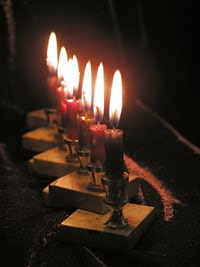
On Chanukah we can use silence as a tool for gaining spiritual insights. When we light the candles we are lighting a spark in our own soul.  We can use this spiritual spark to see how much we have received from Hashem.  The light of Chanukan is the light of clarity of being able to see all of the gifts that Hashem has given us. 

Chanukah: Inner and Outer Connection

Teacher: Mrs. Shira Smiles

Tuesday, November 23, 2010

Struggle For Simcha

When we feel that we’re missing something, we often feel sad. A Jew’s soul naturally thirsts for spirituality. Filling this void with material things only creates a false sense of happiness. We need to ask ourselves, “How much do I enjoy Torah and mitzvot and developing a connection with Hashem?” If we don’t feel a bond with our Creator, then there is no desire to create beauty and joy in the relationship. We need to work on bringing Hashem into our personal lives and infusing our avoda with passion and enthusiasm.  When we have an awareness of where we come from, our achievements and goals, and where we are ultimately headed, then we can begin to understand the purpose of life.


Based on a Naaleh.com shiur by Mrs. Shira Smiles

Wednesday, November 3, 2010

Turn your Torah Into Tefilah ...Rebbi Nachman

How was it that Esav was able to decieve Yitzchak?  The answer is that he looked like a Tzadik, he learned Torah, but he did not internalize it and make it part of himself.  We have to be careful when we learn something to examine ourselves and see how we can make a change in our lives.

We should daven to Hashem to help us to internalize what we have learned.

from: Parshat Toldot: Preferential Parenting

Teacher: Mrs. Shira Smiles
Related Posts with Thumbnails