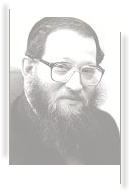
Adi and Tzippi Ginsberg are one of a dozen or so couples who met and married as a result of their participation in the activities of the Committee to Bring Jonathan Pollard Home. They feel they owe a special debt of gratitude to Jonathan, not only for his service to the security of the State of Israel and for saving the lives of Israeli citizens, but also because he was their “matchmaker”! Recently, the Ginsbergs had the opportunity to express their thanks to Jonathan in person when they visited him in prison. This was a first meeting between Jonathan and the young couple and it was, for all concerned, very emotionally charged.
The article below recounting the Ginsburgs’ meeting with Jonathan is being released to mark Pollard’s 9,000th day in captivity, on July 12th, 2010. The Committee to Bring Jonathan Pollard Home has planned a 3 day event at the Gesher Ha’Meitarim (Strings Bridge) Plaza in Jerusalem to raise awareness about Pollard’s abandonment by the State of Israel and to garner support for his release. More information follows the article below.
A number of weeks have passed since we returned from our visit with Jonathan Pollard at FCI Butner in North Carolina.
Ever since we got back to Israel, we have been trying to write a description of our amazing visit with Jonathan but keep running into the same problem. No matter what we write, we continue to have the sense that words simply fall short of capturing the real essence of who Jonathan is, and the impact the visit had on us.
This time, we are taking a different tack by writing an overview, instead of a detailed account. Even so, we write with trepidation.
Jonathan is now 25 years into the unlimited life sentence that was imposed upon him for his service to security of the State of Israel. It may well be that we, or you, or anyone who reading this now, is among those who are alive today thanks to the vital security information that Jonathan shared with Israel – information which the United States withheld from Israel in contravention of an information-sharing agreement signed by both countries.
Jonathan is desperately ill. He suffers from numerous ailments, endures excruciating pain, and has a number of serious medical issues which are not being attended to, even minimally.
His substandard living conditions beggar the imagination. His cell is so narrow that he can barely stretch his arms without touching the walls on either side. He is forced to share this space with another inmate; a murderer, a drug dealer, or a pedophile. Every so often, his cellmates are released to go home, one after the other. Only Jonathan continues to languish in jail – all because he was not able to sit silently by at a time when terrorist plots and weapons of mass destruction loomed as a threat over the heads of the People of Israel.
When you meet Jonathan – a man whose daily life of constant suffering and affliction we have described above only in the smallest part; a man who, by rights, ought to be immersed in anger and bitterness; and who, by now, should justifiably have given up any reason for living – you do not expect to meet the Jonathan Pollard that we met.
Jonathan is not your ordinary prisoner. Nor is he an ordinary person in any way. Despite his deplorable physical condition, and in spite of the inferno he is forced to inhabit, he is remarkably cheerful, upbeat, witty and very compassionate. He has a wonderful sense of humor and an engaging personality.
It was clear to us that Jonathan was in physical pain throughout the visit, from the way he repeatedly shifted in his chair, and from the way he unobtrusively tried to calm the pain by rubbing the afflicted area, but he never said a word about his pain, and he never let on how much he was suffering. Instead, he did everything he could to put us at our ease and to keep the conversation upbeat and encouraging.
Although, we fear being misunderstood on this point, we must share the amazing realization that we had: Jonathan Pollard has been in prison for 25 years, but he has never been a prisoner!
In his bearing, in his attitude and outlook, in his generosity of spirit and in his mental prowess and his intellectual acumen, Jonathan Pollard is a free man. In fact, we have never met anyone quite as free in spirit and in action. This is all the more startling when seen against the Hellish backdrop of the physical circumstances of his incarceration.
There is no such thing as a good prison, or an easy prison. Prison, by definition, crushes free-will, destroys individuality, and forces a person to descend to the lowest common denominator in order to survive. A person in prison has no control over his life. A prisoner cannot make the ordinary every day choices which we take for granted, such as when to eat, what to eat, when to wake up and when to sleep, when to go to the bathroom or take a shower, what to own, where to keep our belongings, when or if to go to the doctor, what to buy, what to read, what kind of work to do, when to make phone calls, how many phone calls to make, or even how many minutes each phone call may last etc.
All the things we take for granted as ordinary freedom of choice and of movement and of will, have been taken away from Jonathan for two and a half decades. An ordinary person would be marked by all the lack and privation Pollard has experienced. An ordinary person would be defined by his circumstances and the limitations in his life. But not Jonathan Pollard! And that is what is so amazing about him and so absolutely impossible to try to explain in writing.
Were it not for the barbed wire, the electronic bars and sliding doors, and the video cameras following our every move in the visit room, reminding us that we were not in a Beit Café in Jerusalem, being with Jonathan almost made us forget where we were.
Jonathan’s smile is engaging. He is warm-hearted and funny. When amused, he chuckles and when he finds something funny he laughs heartily and without restraint.
What touched us the most was watching how his face changed completely when he spoke of his wife, Esther. He did not have to tell us of his endless love for Esther, who has devoted her life to him. He lights up when he speaks of her and simply glows with pride and affection. For him, Esther is his whole world.
My wife, Tzippi, pointed out with some amusement, how much Esther sounds like Jonathan; or is it how much Jonathan sounds like Esther? We have spent many hours and many occasions with Esther in Jerusalem, and were pleasantly surprised to find so much resemblance to Esther in Jonathan; or is it so much resemblance to Jonathan in Esther? How’ ere it be, Esther and Jonathan share the same values, ideals, outlook, and even the same vocabulary. It was endearing to experience first-hand their closeness of mind and soul.
The Pollards reflect a level of trust in HaShem and faith in all His ways that is beyond the grasp of most people. Jonathan wears his faith like a comfortable second skin, something so natural, it does not require a second thought. When Jonathan was incarcerated at USP Marion, where for 7 years he lived in solitary confinement in a dungeon cell 3 stories underground in the worst possible conditions, he was visited by a well-known Rabbi and author. The Rabbi asked him the question that all Jonathan’s visitors like to ask him: “Are you angry at G-d for what He has done to you?”
The Rabbi later wrote that Jonathan immediately responded, “Of course not! Why should I be angry at G-d? G-d did not do this to me, man did!”
We asked Jonathan if, after all these years, he still feels that way. Once again, Jonathan responded without a seconds’ hesitation. “Look,” he said, “HaShem has been very gracious to me! In spite of the harsh conditions and the affliction, HaShem is with me. He sent me a wife while I was in a dungeon cell three stories underground! He sent me my beloved Rav, our adoptive father, Kavod HaRav Mordechai Eliyahu, ztvk”l”. Jonathan’s voice wavered a bit at the mention of his cherished Rav, whose recent death dealt a serious blow to the Pollard couple.
Jonathan continued, “The bad has been horrible, but the good has been incredible! In the depths of Gehinom, Hashem has sent me my closest friends and confidants, and a slew of honest G-d fearing supporters and activists – the best of the best – and He even sent you and Tzippi to me! The evil that has been done to me has been perpetrated by man exercising his own free will, not HaShem. All the good that has been done to me is only from HaShem. In this hell-hole of an existence, it is HaShem who sustains me and keeps me alive, in spite of all odds. Ultimately it is HaShem, in spite of all the rest, who will set me and Esther free.”
We asked him what he meant by “set Esther free”. He said, “Esther and I, because we share our lives so thoroughly, live a very peculiar existence. Because of Esther, I am partially in prison and partially free; and because of me, Esther is partially free and partially in prison too. My release, B”H, will set both of us free.”
After the visit, the NSA monitor who flew in from Washington to audit the visit shared his own thoughts about the “dynamic duo”, Esther and Jonathan. He has monitored Jonathan’s visits for the last 10 years or so, and is thoroughly familiar with the Pollard couple. He told us that he believes that were it not for Esther, the love of Jonathan’s life, it is not likely that he would have survived this long. “Esther is the air that he breathes! She is the blood in his veins!” is how he put it.
Even after 25 years of affliction and deprivation, we met a humble and elegant man, a most articulate man, who almost never said a word about himself. He did speak at length and with great animation of the “other love of his life”— the Land and People of Israel. He said that his beloved Rav, HaRav Mordechai Eliyahu, ztvk”l had pointed out to him that the two great loves in his life share the same initials “E. Y.” (Aleph, Yod); his wife, (E)sther (Y)ocheved and (E)retz (Y)israel, the land of Israel. This, said the Rav zt”l, who was a great Mekubal, is no coincidence!
The fate of the People of Israel and the safety of the Land of Israel disturb Jonathan’s peace more than any other subject. From the depths of Gehinom, deep inside the pit, he prays for us, even for those who forget to pray for him.
Even now, weeks after the visit, we are still not able to understand or to explain Jonathan’s freedom of spirit, his strength of belief, his endless hope, and his ability to be so full of light in an atmosphere so totally immersed in darkness. In spite of it all, he is a man of great loving-kindness and grace.
Similarly, we still have not yet found a way to write a blow by blow description of the visit that doesn’t diminish what an amazing person our brother Jonathan is. It hurts to know that this very, very precious soul has been buried alive in prison for so many years, and is still waiting for us to dig him out.
During the course of our conversation, Jonathan asked me about my goals for the future and I responded in detail. He turned to my wife and said, “Tzippi, all of Adi’s dreams depend on you! Your mission is to create the kind of loving, safe, secure, Jewish home that Adi needs so that he can have the peace of mind and the focus he needs to be able to devote his full heart and soul to fulfilling these lofty goals!” Tzippi, deeply touched, burst into tears. Smiling through her tears, she nodded in agreement.
Then Jonathan turned to me, and said, “And your job, Adi, is to honor and cherish the precious gift that HaShem gave you in your wife, Tzippi!”
“Adi,” he admonished me, “never forget, no matter what else you may do in your life, no matter what you may accomplish, without her, you are nothing!” His words, spoken from the heart, entered our hearts and touched us deeply.
Another thing which Jonathan said, totally blew us away.
It was when we spoke with him about Shlomit Peretz, the young widow of Golani Commander Eliraz Peretz, who was killed in Gaza on the eve of last Passover. Not only did Shlomit have to deal with the harsh blow that the death of her husband dealt her, but also with the news that their house (home to her four little orphans) was slated for destruction by the Government. When the Knesset Speaker came to pay her a condolence call, she did not use the opportunity to speak to him about herself or about saving her house. The only thing that she had to say to the Knesset Speaker Reuven Rivlin was a plea for Jonathan Pollard:
"One of the values that was very strong with Eliraz is that the wounded are not to be abandoned in the field," she told Rivlin. "I want to point out to you something about this value of not abandoning the wounded," she went on. "The State of Israel has someone who has been left wounded in the field for 25 years [Jonathan Pollard] and our hearts are torn. If he could be brought home, that would be a sort of consolation for us. I would see in that a continuation of Eliraz's path, that despite the fact that Eliraz is no longer with us physically - the things that he wanted to happen and in which he believed will be fulfilled."
Prior to our visit we had heard (from Esther) Jonathan’s response to Shlomit Peretz’s bravery. Jonathan had said he was humbled and amazed by the moral strength and courage of a woman, newly-widowed, who at such a difficult time, asked nothing for herself, but instead used the opportunity to do something to promote the values that her late husband, Eliraz, had lived and died for.
But now, as we were speaking, Jonathan added a few words that hit us like a ton of bricks. He said, “You know, sometimes I am really surprised to discover that there are still people who remember me…”
Jonathan’s words tore our hearts out! How could it be that we, as a nation, have failed so miserably to convey our caring and concern for this precious soul, who sacrificed his life and his freedom for us? How can we face ourselves knowing that we allowed him to feel so alone, so forgotten?
Friends, in practical terms, Jonathan’s release depends on the Government of Israel ending the abandonment and taking responsibility by implementing intensive action to return Jonathan home. But the responsibility for how we relate to Jonathan is ours and ours alone!
If after 25 years, Jonathan does not feel that there is an entire nation waiting for him over there, beyond the prison walls; a nation praying for him, doing everything it can, and waiting expectantly, impatiently for him, a nation that won’t give up on him until he is home – if Jonathan is still surprised to learn that someone here cares about him –
then we have to ask ourselves what this says about us.
What is more, if we were really concerned about the one who has paid and is paying such a heavy price for caring about us, then we would arouse ourselves to figure out the most effective way to cry out as one, demanding his release. If we would only show that we really care, that Jonathan really matters, the opportunity would arise and a solution can be found, and Jonathan’s life saved.
One thing is certain, if Jonathan were to begin receiving thousands of letters every week, from his concerned brothers and sisters in Israel, who write to tell him about the efforts that they are making for his release, he would no longer be so surprised that anyone remembers him. He would know it for certain.
Then perhaps we may, through our efforts, transform ourselves into a nation deserving of having this great man home with us.
The worst moment of our visit arrived when we had to say good-bye to Jonathan. If Jonathan were an ordinary man and an ordinary Jew, we would still be very, very sad to leave him there. How much sadder we were to turn our backs and have to walk away from a man who is a national treasure, a man who could make such a difference at home. Among other things, Jonathan has been working for years on projects for the creation of alternate sources of energy. He has plans and ideas to help Israel become self-sufficient in the areas of energy production and water purification and recycling. His greatest dream is to help Israel end its dependence on foreign sources of energy.
The visit room guard signaled, “time up” and we gathered up our belongings and our hearts, ready to leave. We were devastated by the thought of Jonathan returning to his tiny cell and his life in hell, but there was nothing we could do. We hugged him and said our good-byes, pledging to meet again soon in Jerusalem. With heavy, heavy hearts, we wiped the tears from our eyes and followed the NSA monitor out through the door marked “Exit”.
When will it be Jonathan’s turn to walk through that door?
By: Adi and Tzippi Ginsberg
(To read more about the plight of Jonathan Pollard, see http://www.JonathanPollard.org)
 Tu'Av is a time of Shiduchim. In light of this I want to share an insight about marriage that Rebbeztin Kalmonovitz told me. Every person is really only half of their true neshamah, their spouse is the other half. This might be an upsetting thought at times when we are frustrated with our spouse (which every person experiences at some time). The way to appreciate this reality is to realize that after we leave this world and go to the world of emes, we will go through a process of spiritual purification, and so will our spouse. Then our souls will be reunited in their pure states. Look at your spouse and say to yourself, "there is a pure neshomah inside of him/her that is part of my neshomah"