TIforOA

Sanctify yourself through the permissible... Yevamos 20a

Divrei Torah to provide Chizuk in the struggle to balance spiritual and physical needs.

L'Iluei Nishmas Mirkah Bas Yosef


Thursday, February 2, 2012

Life is a dream

It is brought down in the Talmud that the interpretation of a dream determines the reality of the dream.  If it is interpreted for good, it will be good.  Rabbi Label Lam says that our lives are life a dream.  If we interpret them for good, they will be good, and if we look at our lives in a negative way, that is the way they will be.

from this Shiur on Torah Anytime:


http://www.torahanytime.com/scripts/media.php?file=media/Rabbi/Label_Lam/2012-01-01/Reaching_Happiness_NOW/Rabbi__Label_Lam__Reaching_Happiness_NOW__2012-01-01.wmv

Thursday, January 26, 2012

The secret of happiness-from Rabbi Kirzner

Rabbi Label Lam says that he once heard Rabbi Kirzner say that the secret of happiness is  "expect nothing".    There is an oa saying, "An expectation is a planned resentment".  Rabbi Lam explains that while this might sound negative, it is really very positive.  It is saying that every little thing in your life should make you happy.

from:
http://www.torahanytime.com/scripts/media.php?file=media/Rabbi/Label_Lam/2012-01-01/Reaching_Happiness_NOW/Rabbi__Label_Lam__Reaching_Happiness_NOW__2012-01-01.wmv

Monday, January 23, 2012

"I'm not different"


When Yakov struggled with the angel and won, he asked the angel what his name is and he refused to answer. Rabbi Wallerstein said that the angel's name (the Yetzer Hara) is, "I'm different". Everyone thinks that "I'm different, I can do what I want and get the results that I want"  But that is the trick of the Yetzer Hara, he wants us to think that we are different and we don't need the rules and regulations of the Torah.  If we want to grow in Yiras Shamayim we have to realize that we are not different.

from a Shiur on Torah anytime:

http://www.torahanytime.com/scripts/media.php?file=media/Rabbi/Zecharia_Wallerstein/2011-12-21/You_are_the_Miracle/Rabbi__Zecharia_Wallerstein__You_are_the_Miracle__2011-12-21.wmv

Thank you Hashem for a year without Yishuv Hadas.

In a Shiur by Shira Smiles on Parshat Viera she said that we have to thank Hashem for what we don't have, not just what we have.  She also spoke about the reason that the frogs were such a difficult Maka was that they robbed the Egyptians of their Yishuv Hadas.  In light of this I am trying to find a way of thanking Hashem for the fact that I have not had any Yishuv Hadas for almost a year now.

  I have a lot to be thankful for in the past year, Health Insurance, warm and caring family members and doctors who helped me through a difficult time, modern medicine which makes major problems livable in the long term, and so much more.  But Yishuv Hadas was not there.  The longer that I think about this whole year, I feel that the biggest message that I can take out of it is that Hashem runs the world not me.  While this may seem obvious, it is a hard message to internalize.  I kept thinking that if I called one more doctor, or looked up one more thing on the internet, I would find an easy solution.  There are no easy answers.  Hashem is the final address for all of our problems.  To paraphrase Rabbi Weinberg from Aish,  we turn to Hashem for the answers to our problems, but we forget that Hashem gave us these problems to cause us to turn to him.

Therefore, I am thanking Hashem for my difficult year, with no Yishuv Hadas, because it helped me to internalize the fact that I can do and do and do.  But if Hashem does not want things to go well they won't. The opposite is also true.  I can make tremendous efforts to solve a problem, only to come up with a blank wall, and then I can turn around and find the solution fall into my lap through no effort of my own.

The biggest cost of my difficult year has been this blog.  Without Yishuv Hadas I was not able to post much. I am trying to get back to it, and I greatly appreciate all of the help that everyone has given me, in the past, and I hope to bring my blog back to it's former self.

Friday, December 23, 2011

The message of the dreidel.

A dreidel is only able to turn when the hand on the top spins it and makes it go.  This is like our lives.  Without the hand from above (Hashem) our lives are worthless.

Heard on a Torah Twelve Step meeting from Jenette in Panama.

Sunday, December 11, 2011

I held the Baal Shem Tov's Siddur.


Sometimes you just feel like you have to do something.  This Shabbos when I read about the Auction of Important Judaica at Sotherby's I got it in my head that I had to see it.  I couldn't find someone to go with me so I hoped into my car and went by myself.  One person said, "I can't believe that you are driving for two hours to see a Siddur in a glass box."  Never in my wildest dreams did I think that they would let me touch it.  Well not only did I see it but I got to hold it.  I am so glad that I went, and it shows me that if something feels important to me, it is worth it to follow a dream.

Thursday, December 8, 2011

Building an eternal creation.

Sometimes when a builder builds a tall building he puts up a scaffolding to help him to build.  Would he ever dream of building it out of gold?  Of course not, the scaffolding is only temporary.  This is a good Mashal of our lives.  Our lives are temporary, but the eternal creation of our neshamah is for ever.  We should put the emphasis on the eternal creation and not our physical existence.  


Parshat Vayishlach: Faithful Follower
Teacher: Mrs. Shira Smiles Class:

Parsha For Our Lives 5772

Added: December 05, 2011 


http://www.naaleh.com/viewclass/2913/single/

Wednesday, December 7, 2011

Learning to Live the Torah

When Yakov says, "I lived with Lavan"  we learn from this that he kept all 613 mitzvot.  How can we say that he kept all of the Mitzvot?  The answer that Mrs. Smiles gives is that by learning all of the mitzvot and having the intention to carry them out, to the best of our ability, we are credited with keeping them.  She adds that this means not just keeping the mitzvot, but keeping the intent of the mitzvot.  She gives the example of Tznius, which does not only mean modest dress, but modest behavior.  I was recently reading the following post from Neil Harris:   http://uberdox.blogspot.com/2011/11/reb-moshe-and-broken-tape-recorder.html  where he told the folloing story that illustrates this idea, of not just learning Torah, but absorbing it.


Some years ago, in Rav Reuven Feinstein's yeshiva, there were two boys who had an argument.  What happened?  Let's call them Reuven and Shimon.  Revuen lent his tape recorder to Shimon and Shimon dropped the tape record and it broke.  And they were arguing.  Revuen said, "I lent you the tape recorder and you broke it.  You have to get me a new one."
Shimon says, "It wasn't my fault, it was an accident."
And they were arguing and decided that they would go to the Rosh Yeshiva, which is a good thing.  They went to Reb Reuven Feinstein, they went to the Rosh Yeshiva to ask him what's the halacha then.  This is what happened.  Rav Reuven Feinstein was absolutly astonished by the question.  Not with nachas, he was astonished.  He said, "You're learning all year since September, your learning the gemara.  Everyday you have charts on the blackboard.   You're learning the gemara "Bava Metzia" that teaches that when someone borrows something he's responsible when it breaks.  If you borrow something you're responsible."  Rav Reuven was so distrubed by this.  He couldn't understand how's it possible that the boy, how could he not know that? That's all they're learning and they're getting 100s on their tests. שואל חייב באונסין , it's a gemara.  It's all over the gemara.  If you borrow, you're chai'ev (responsible).
So, he was so upset, Rav Reuven went to his father.  He went to Reb Moshe, Zecher Tzaddik V'Kodesh L'Vracha.  He went to Reb Moshe and he asked, "How can it be that the boys did not know that?"
So, Reb Moshe said, "Because what they've seen in their lives has no relationship to what they're learning in yeshiva.  It's completely irrelevant.  They do not see their parents living the lives that they learn in the seforim, nor do they see it so clearly in the yeshiva."  That's what Reb Moshe said.
They would never dream of making a connection between what they learned all year and how to practically live.  It might have been taught, but it wasn't given over.


Dvar Torah from:


Parshat Vayishlach: Faithful Follower
Teacher: Mrs. Shira Smiles Class:

Parsha For Our Lives 5772

Tuesday, December 6, 2011

Things to give up-from an Alanon Group

> 1. Give up trying to be perfect. – The real world doesn't reward perfectionists, it rewards people who get things done.
>
> 2. Give up comparing yourself to others. – The only person you are competing against is yourself.
>
> 3. Give up dwelling on the past or worrying too much about the future. – Right now is the only moment guaranteed to you. Right now is life. Don't miss it.
>
> 4. Give up complaining. – Do something about it.
>
> 5. Give up holding grudges. – Grudges are a waste of perfect happiness.
>
> 6. Give up waiting. – What we don't start today won't be finished by tomorrow. Knowledge and intelligence are both useless without action.
>
> 7. Give up lying. – In the long-run the truth always reveals itself. Either you own up to your actions or your actions will ultimately own you.
>
> 8. Give up trying to avoid mistakes. – The only mistake that can truly hurt you is choosing to do nothing simply because you're too scared to make a mistake.
>
> 9. Give up saying, "I can't." – As Henry Ford put it, "Whether you think you can or you think you can't, you are right."
>
> 10. Give up trying to be everything to everyone. – Making one person smile can change the world. Maybe not the whole world, but their world. Start small. Start now.
>
> 11. Give up thinking you're not ready. – Nobody ever feels 100% ready when an opportunity arises. Because most great opportunities in life force us to grow beyond our comfort zones, which means we won't feel totally comfortable at first.
>
> 12. Give up setting small goals for yourself. – Many people set small goals because they're afraid to fail. Ironically, setting these small goals is what makes them fail.
>
> 13. Give up trying to do everything by yourself. – You are the sum of the people you spend the most time with. If you work together, you will be far more capable and powerful than you ever could have been alone.
>
> 14. Give up buying things you don't need. – Manage your money wisely so your money does not manage you. Do not spend to impress others. Do not live life trying to fool yourself into thinking wealth is measured in material objects.
>
> 15. Give up blaming others for your troubles. – The extent to which you can live your dream life depends on the extent to which you take responsibility for your life. When you blame others for what you're going through, you deny responsibility – you give others power over that part of your life.
>
> 16. Give up making mountains out of molehills. – One way to check if something is worth mulling over is to ask yourself this question: "Will this matter in one year's time? Three years? Five years? If not, then it's not worth worrying about.
>
> 17. Give up trying to live up to the expectations of others. – Work on it for real and exceed your own expectations. Everything else will fall into place.
>
> 18. Give up the `easy street' mentality. – There is too much emphasis on finding a `quick fix' in today's society. For example taking diet pills to lose weight instead of exercising and eating well. No amount of magic fairy dust replaces diligent, focused, hard work.
>
> 19. Give up making promises you can't keep. – Don't over-promise. Over-deliver on everything you do.
>
> 20. Give up letting your thoughts and feelings bottle up inside. – People are not mind readers. They will never know how you feel unless you tell them.
>
> 21. Give up beating around the bush. – Say what you mean and mean what you say. Communicate effectively.
>
> 22. Give up avoiding change. – However good or bad a situation is now, it will change. That's the one thing you can count on. So embrace change and realize that change happens for a reason. It won't always be easy or obvious at first, but in the end it will be worth it.
>
> 23. Give up your sense of entitlement. – Nobody is entitled to anything in this world. We are all equal. We breathe the same air. We get what we give. We get what we earn.
>
> 24. Give up waiting until the last minute. – Those who fail to plan, plan to fail.
>
> 25. Give up being dramatic. – Stay out of other people's drama and don't needlessly create your own.
>
> 26. Give up being anti-athletic. – Get your body moving! Simply take a long, relaxing walk.
>
> 27. Give up junk food. – You are what you eat.
>
> 28. Give up eating as a means of entertainment. – Don't eat when you're bored. Eat when you're hungry.
>
> 29. Give up foolish habits that you know are foolish. – Don't text and drive. Don't drink and drive. Don't smoke. Etc.
>
> 30. Give up relationships with people who bring you down. – Saying "no" to right people gives you the time and resources required to say "yes" to right opportunities. Spend time with nice people who are smart, driven and likeminded.
>
> 31. Give up being shy. – Network with people. Meet new people. Ask questions. Introduce yourself.
>
> 32. Give up worrying about what others think of you. – Unless you're trying to make a great first impression (job interview, first date, etc.), don't let the opinions of others stand in your way. What they think and say about you isn't important. What is important is how you feel about yourself.
>
> 33. Give up trying to control everything. – Life is an unpredictable phenomenon. No matter how good or bad things seem right now, we can never be 100% certain what will happen next. So do you best with what's in front of you and leave the rest to the powers above you.
>
> 34. Give up doing the same thing over and over again. – In order to grow, you must expand your horizons and break free of your comfort zone. If you keep doing what you're doing, you'll keep getting what you're getting.
>
> 35. Give up following the path of least resistance. – Life is not easy, especially when you plan on achieving something worthwhile. Don't find the easy way out. Do something extraordinary.
>
> 36. Give up persistent multi-tasking. – Do one thing at a time and do it right.
>
> 37. Give up thinking others are luckier than you. – The harder you work, the luckier you will become.
>
> 38. Give up filling every waking moment with commitments and activities. – It's okay to be alone. It's okay to do nothing sometimes. Think. Relax. Breathe. Be.
>
> 39. Give up making emotional decisions. – Don't let your emotions trump your intelligence. Slow down and think things through before you make any life-changing decisions.
>
> 40. Give up doing the wrong things just because you can get away with it. – Just because you can get away with something doesn't mean you should do it. Think bigger. Keep the end in mind. Do what you know in your heart is right.
>
> 41. Give up focusing on what you don't want to happen. – Focus on what you do want to happen. Positive thinking is at the forefront of every great success story. If you awake every morning with the thought that something wonderful will happen in your life today, and you pay close attention, you'll often find that you're right.
>
> 42. Give up taking yourself so seriously. – Few others do anyway. So enjoy yourself and have a little fun while you can.
>
> 43. Give up spending your life working in a career field you're not passionate about. – Life is too short for such nonsense. The right career choice is based on one key point: Finding hard work you love doing. So if you catch yourself working hard and loving every minute of it, don't stop. You're on to something big. Because hard work ain't hard when you concentrate on your passions.
>
> 44. Give up thinking about the things you don't have. – Appreciate everything you do have. Many people aren't so lucky.
>
> 45. Give up doubting others. – People who are determined do remarkable things. Remember, the one who says it can't be done should never interrupt the one doing it.
>
> 46. Give up fussing with every beauty product on the market. – Good looks attracts the eyes. Personality attracts the heart. Be proud to be you. That's when you're beautiful.
>
> 47. Give up trying to fit in. – Don't mold yourself into someone you're not. Be yourself. Oftentimes, the only reason they want you to fit in is that once you do they can ignore you and go about their business.
>
> 48. Give up trying to be different for the sake of being different. – Nonconformity for the sake of nonconformity is conformity. When people try too hard to be different, they usually end up being just like everyone else who is trying to be different. Once again, be yourself.
>
> 49. Give up trying to avoid risk. – There's no such thing as `risk free.' Everything you do or don't do has an inherent risk.
>
> 50. Give up putting your own needs on the back burner. – Yes, help others, but help yourself too. If there was ever a moment to follow your passion and do something that matters to you, that moment is now.
>
>
>
> ~ Author Unknown
>

Monday, December 5, 2011

A personal reflecton on Gam Zu L'Tova

As you may have noticed I have not been able to post much for the past nine months.  Someone that I am very close to has gone through a major medical crisis.  Baruch Hashem, now that it is almost over I can look back and see that many of the things which caused us so much pain at the time were actually the source of future Bracha.  The biggest thing that stands out in this area was that there were 2 ways of treating the problem with medicine or with surgery.  When the medicine failed I was devastated.  At the time that he started taking the medicine we had to sign that we knew that the medicine could cause cancer but we were told that it was a one in 20,000 chance.  Recently I met someone who was that one, and he had to have the surgery anyway and deal with cancer.  Now as I look back I am so grateful to Hashem that the medicine did not work!  I am so grateful to Hashem that he is running the show not me.

Feeling the Kedusha of the Menorah

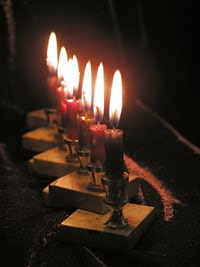
The Baal HaTanya says that you can not fill a cup of water with wine. You have to empty the cup in order to fill it.  The same holds true for spirituality.  If your mind is full of physicality you will not be able to absorb spirituality.  When you light the menorah you have to make sure that your mind is not focused on physical things so that you can feel the Kedushah of the menorah.


Chanukah: Sfas Emes Part 1
Teacher: Rebbetzin Tziporah Heller Class:

Jewish Calendar II (Chanukah


http://www.naaleh.com/viewclass/356/single/

An important thing to keep in mind when posting and commenting on line.


Day 72 - To a Non-Jew

SEFER CHOFETZ CHAIM — Laws of Loshon Hora 8:12

At one time or another, we hear derogatory remarks about Jews. It is tragic enough when such remarks are made by Jews to Jewish listeners. Even more tragic is when they are told by Jews to co-workers, business associates, or others who are not Jewish. The subject of these remarks might be an individual Jew, a specific group of Jews, or Jews in general.

The Chofetz Chaim declares that to speak loshon hora about a Jew when the listener is a gentile is a much greater sin than when the listener is a Jew. One who is guilty of this sin “disgraces the honor of Israel and desecrates the Name of Heaven.”

There is yet another reason for the particular severity of this sin. When one speaks loshon hora to a fellow Jew, there is a possibility that the listener will not be quick to accept the report as fact—especially if he is someone familiar with the laws of loshon hora. Gentiles, on the other hand, certainly do not have a predisposition towards judging Jews favorably. Upon hearing the derogatory report, the gentile will be quick to believe it and pass the information on to others.

When a Jew denigrates other Jews in the presence of gentiles, he is, in essence, contradicting the purpose of his own existence. Our mission in this world as a people is to spread the honor of Hashem by serving as His representatives before the rest of the world. We say in Shema each day: “V’Ahavta es Hashem ElokechaAnd you shall love Hashem, your God (Devarim 6:4). Our Sages teach (Yoma 86a) that we demonstrate our love of Hashem by making His Name beloved in the eyes of others. When a Jew studies Torah, speaks pleasantly to people and deals honestly in business, then people say, “Praiseworthy is the father who taught him Torah; praiseworthy is the teacher who taught him Torah. See how beautiful and correct are his ways and deeds.”

Thus the damage caused by relating loshon hora to gentiles goes far beyond loshon hora, which is devastating in itself. Instead of using his abilities to increase Hashem’s honor, the speaker has been guilty of chillul Hashem (desecration of Hashem’s Name).
from the Chofetz Chaim Heritage Assoc.

Tuesday, November 29, 2011


In a Shiur by Rebbetzin Kalmonovitz she said that Hashem gets tremendous Nachas from us telling stories of the Tzadikim becuase it inspires us to improve ourselves.  Therefore I am posting this from:
http://www.JewishWorldReview.com |

  Two reporters, Israel correspondents from international secular publications, called the other day. Each was seeking the "truth" about supposed controversies within the fervently-Orthodox world.
I told both the same thing: Stop wasting your time on fringe groups and trivial issues. If you want to understand the "ultra-Orthodox" community, first find out why over a 100,000 people attended the funeral of Rabbi Nosson Tzvi Finkel, with tens of thousands of adults sobbing openly and unashamedly. If you want to understand a person or a community, observe what he or they honor: "[A] person [reveals himself] according to what he praises" (Proverbs 26:21).
Who was the remarkable man whose passing inspired such grief?
When Rabbi Finkel took over the reins of Jerusalem's Mirrer Yeshiva from his father-in-law, Rabbi Beinish Finkel, zt"l, in 1990, he had already been diagnosed with Parkinson's Disease. Many wondered how he could carry the burden of a yeshiva (rabbinical academy) that numbered 1,000 married and unmarried students. Yet under his leadership the yeshiva expanded rapidly. New buildings were built; another branch was started in a community outside Tel Aviv. One sage quipped that Rabbi Nosson Tzvi might as well put a roof over the entire neighborhood and call it Mirrer Yeshiva. Today, 6,000 students learn in Mirrer Yeshiva's many study halls, making it the largest yeshiva since the closing of the Talmud, perhaps the largest ever.
"Even when I lie down, I can't rest because of the trembling," from Parkinson's Disease, he told one of his brothers-in-law, "so I think of ways to spread Torah." Our Sages say that the Ark carried those who carried it. And so it was with Rabbi Nosson Tzvi. After one long flight to Los Angeles, a crying stewardess told those who came to the airport to meet him, "Promise me you'll never let him do this again. How could you do this to this holy man?" When people accused his brothers-in-law of "shlepping him" on grueling trips, they replied, "We don't shlep him, he shleps us."
He used his debilitating disease to build more Torah and to teach. A rich businessman refused his request for a large donation. "I can't," he said. The sage told him, "I can't either, but I do anyway." He received the donation.
THE SAGE AND THE CEO
Howard Schultz, the founder of Starbucks, was once was brought to see Rabbi Finkel, along with a group of prominent businessman. They had not been told of his Parkinson's, and instinctively averted their eyes when he entered the room. Soon they heard a bang on the table and Rabbi Nosson Tzvi commanding them, "Look at me." "I know you are all busy men," he continued, "so I'll be brief. What is the most important lesson of the Holocaust?"

He proceeded to describe the situation of the Jews arriving in Auschwitz and other death camps, after being packed into cattle cars for days, without water or facilities of any kind, and then being separated from their loved ones. When the lucky ones reached a barracks, they were given one blanket for six people. They could choose to share it or each one could try to grab it for himself. They chose the former. "The greatest lesson of the Holocaust," he concluded, "is the triumph of the human spirit. Now, each of you return to America and share your blanket with five others."


Someone once asked him for advice on how to learn Torah, even amidst afflictions. Rabbi Nosson Tzvi told him that he didn't know: "I learn with great simcha [joy]." He refused to take the strongest medicines to control his disease for fear they would cloud his mind or rob him of his memory. The sage often learned in a freezing room to be able to meet his daily quotas in learning.

When he mounted the podium in Mirrer Yeshiva to give a lecture in the main study hall, he had to hold fast to two shtenders (lecterns) to remain upright and he never knew whether he would be able to control his tongue sufficiently to speak. Once he was thrown by a violent tremor from his position lying on a couch onto the floor, in the middle of learning with a student. Even before he could be helped up, he was asking his study partner to repeat the interpretation he had been offering.
Just as one would not begrudge the money spent to ransom a loved one, he viewed his ordeals as trivial price to pay for teaching and building Torah, and not as self-sacrifice. Everywhere he went, people of all ages rushed to be within his four cubits and witness a soul that had so transcended the limits of the imperfect vessel of his body.
OUR SAGES GIVE several possible explanations for the tests with which a tzaddik ( saintly person) is afflicted. Sometimes those tests serve to actualize his potential; sometimes to publicize his greatness. I will never forget the first time I saw Rabbi Nosson Tzvi, over thirty years ago, at the wedding of a former student. I had no idea who he was, but I could not take my eyes off of him. A Mona Lisa smile did not leave his lips the entire time I watched. It conveyed goodness and love and joy in a student's lifecycle event. I asked someone, "Who is that man who looks like an angel?" The special qualities were already there.

NATTIE, THE CUBS FAN
With love he inspired thousands of young men to reach heights that they never dreamed possible. In Mirrer Yeshiva, under Rabbi Nosson Tzvi, it did not matter where you were from, your family connections, or how high your IQ: Rabbi Nosson Tzvi was prepared to help each student reach his potential. He never forgot that he arrived at Mirrer Yeshiva, a lanky teenager called Nattie from a coed Jewish high school in Chicago, wearing a Cubs hat (though, he quipped, the golf clubs were left behind.) From his days as a young newly wed until he was felled by a sudden heart attack, he made it a practice to establish study sessions with any student who requested one.

A senior sage several decades Rabbi Nosson Tzvi's senior once came to visit him. Despite Rabbi Nosson Tzvi's protests, the older scholar insisted it was incumbent upon him to visit someone who knew 3,000 students by name. "I'm not sure if I know each one by name," Reb Nosson Tzvi said, "but I love each one." All those who entered the Mir found out that it was true.
A ba'al teshuva (one who reclaims his heritage through observance) recently arrived in Mirrer Yeshiva from Ohr Somayach could not find the special penitential prayers in an unfamiliar prayerbook. His humiliation was rising by the second, until Rabbi Nosson Tzvi, who had somehow noticed his discomfiture, came rushing over with a siddur open to the proper page. Such stories are legion: Rabbi Nosson Tzvi checking on young disciples in their sealed rooms during the Gulf War; Rabbi Nosson Tzvi personally taking a lad who fainted in a lecture to a doctor and then insisting that he move into the crowded Finkel home; Rabbi Nosson Tzvi looking for an apartment to rent with a student about to be married; Rabbi Nosson Tzvi, just back from a fundraising trip abroad, crying at the beginning of his Friday Chumash (Bible) class because "I missed you all so much."
Those who were sure the sage would not remember them from years before in the yeshiva were astonished to be greeted as "My Chaim," in a long receiving line, or to be reminded of a difficulty they had posed to the sage a decade earlier. Some sought to avoid imposing on Rabbi Nosson to officiate at their weddings, which entailed him arriving in a wheel chair and being assisted by at least two others to the chuppah. To no avail. Inevitably they would receive a call in the middle of wedding that the Rabbi Nosson was outside and wanted to wish the new couple Mazel Tov. A former student from America begged him not to attend his son's bar mitzvah at the Western Wall. "I missed your wedding fifteen years ago; I'm not missing the bar mitzvah," Rabbi Nosson Tzvi told him.
"Not a blade of grass grows unless an angel strikes it and says, 'Grow," our Sages teach. Rabbi Nosson Tzvi was that angel for tens of thousands of students and dozens of promising young scholars whom he appointed to give classes in Mirrer Yeshiva. But above all, it was his smile, the way he grasped your hand in both of his.
Mendy entered Mirrer Yeshiva after an indifferent career in other rabbinic schools. But Rabbi Nosson Tzvi was always ready to provide another chance. Towards the end of a long five-month winter zman (semester), the sage announced that he would like the unmarried students to commit to studying Talmud 12 hours a day, without any breaks. It never occurred to Mendy that the sage could mean him. A few days later, Mendy was approached and asked why his name was not on the sign-up.
Mendy could not believe that he had noticed the absence of his name among hundreds of names. But when he saw the Rabbi Nosson Tzvi was serious, he too signed up. The first days were very difficult. But after dropping into bed exhausted on the third night of the new regime, Mendy found himself dreaming about the Talmud in his sleep. The next morning he told this surrogate father what had happened. Rabbi Nosson Tzvi started dancing with him spontaneously in the packed study hall.
Now you know why we are weeping.

Wednesday, November 23, 2011

A Wonderful Collection of OA sayings-Thanks Goldie

it works if you work it

those who judge do'nt matter, those who matter, do'nt judge

if you don't share it, you wear it

you come fror the vanity, you stay for the sanity

if you dont want to fall off the cliff, dont walk on the edge

the things you dont want to do are the things you really need to do

better a wrinkled prune than a fat plum

the problem in front of me is not as bad as the problem behind me

one bite is too much, but a thousand is not enough

the only place success comes before work is in the dictionary

if you do what you've always done  you get what you've always gotten

only hashem can lift my mental obsession, and i have to ask for it one day at a time

i am responsible only for my own actions

if i fail to plan,i plan to fail

practice progress not perfection

overeating is a state of mind not a diet problem

Hashem doesn't want us to do anything compulsively

Hashem is doing for us what we couldnt do for ourselves

Hashem took me to it, Hashem will bring m through it

trust, rely, and depend on Hashem

we eat because we are  Hurt  Angry Lonely  Tired

do'nt stuff your face, face your stuff

hurt people - hurt people

nothing tastes as good as abstinence feels

work is what i do between meetings

time takes time

dont pick up-no matter what

when you watch your weight, you lose your program- when you watch your program, you loose your weight

with Hashem help i can do anything

success is a journey, not a destination

trust Hashem, clean house, serve others

you dont need will power , you need Hashem power

yesterday is history, tomorrow is a mystery today is a gift, thats why we call it the present

say no without feeling guilty, say yes without feeling resentment

we are responsible for what we do no matter how we feel about it

either you control your attitude or it controls you

a head full of program prevents a body full of food

the monkey's off my back , but the circus is still in town

we need to put less faith in our efforts and more effort in our faith

NUTS not using the steps

FEAR  forgotten everything's all right

FEAR  false evidence appears real

FEAR face everything and recover

fear is the absence of faith

fear is a darkroom where negative thoughts are developed

dont leave before the miracle 

develop an attitude of gratitude

i didnt cause it, i cant control it, i cant cure it-- just let Hashem do it

we are skating on thin ice any time  we seek comfort in anything other than Hashem

worry doesnt prevent disaster, it prevents joy

worry does not empty tomorrow of its struggles, it empties today of its strengths

acceptance is the answer to all my problems today

worry is like a rocking chair- it keeps you busy but it doesnt get you anywhere

pick up the phone,not the food

service is slimming

keep it simple,surrender

a mistake is not a mistake, its a learning experience

sliver ->slice -> slab -> slob

WE ARE NOT IN CONTROL

happy moments-----------------praise Hashem
difficult moments---------------seek Hashem
quiet moments------------------pray to Hashem
painful moments----------------trust Hashem
every moment-------------------thank Hashem

Saturday, November 5, 2011

Lech Lecha- One Day at a Time

When Hashem told Avraham to leave his birthplace, Hashem did not tell him where he was going.  This was a major part of his Nisayon.  To know that he had to do Hashem's will, even if he didn't know what it was in the long term.

Avraham's Nisyonos are ours.  Every day when we wake up we have to focus on doing what Hashem wants us to do that day.  We don't have to know what the long term plan is, we just have to focus on doing Hashem's will that day.  The difficulties, and setbacks that come up are often Hashem's way of directing us to where he wants us to go, and we have to be flexible and make the most of what Hashem sends us.

Based on Rabbi Parkoff's book  "Trust Me"
Related Posts with Thumbnails